Showing posts with label Cemetery. Show all posts

Saturday, September 10, 2011

Irish Round Tower, Milford


Why are there so many stone towers in New England? Because Rock is abundant in the region? While I was in the Midwest for a few years, I didn't come across a single stone tower... Now my guess game starts here: when the European settlers cultivated the land they needed to clear chunks of rock. Creating a mound after mound of rock pile was way too boring and impractical. Instead of doing so, they piled rocks up for boundary hedges. That's practical, but it's not quite a fun yet.

Yet Puritans didn't fancy the concept of fun, after zillions of boundaries they might become "creative" with the use of the cleared rock: "Why don't we create some watching towers? We need to keep our properties free from intruders!" Ok, it does sill sound full of practicality sans fun, but you can at least tweak the design to distinguish one tower from another. And then it became a part of vernacular architectural style... That's my complete fancy.

(I'm not the only one fantasizing about New England towers' origins; take a look at the case with Newport Tower in Rhodes Island!)


One day, my Irish husband B. said: "those towers look like medieval towers in Ireland. Maybe there's something to do with Irish." Huh, good point. Come to think of it, the Irish field is as rocky as the New England counterpart. Not surprisingly, our state Massachusetts has the only Irish Round Tower in North America!


The Tower is in a Roman Catholic cemetery in Milford. St Mary Cemetery of Milford was established in 1839, and the tower was built in 1894 to commemorate Irish immigrants of the town. Milford is notable for its Milford Granite. The pink granite stone become fashionable during the 1870's, and the business trend supplied employment to the immigrants.

The supply of stone (nice one!) and Irish masons were plentiful, why not build an Irish round tower, right?


This cemetery is serenely quiet. I know, cemeteries are the synonym of quiet, but there are different tones in it. For example, state hospital cemeteries are sadly quiet. Well maintained cemeteries are peacefully quiet. Mt. Auburn Cemetery in Cambridge is lively quiet... I know it sounds strange, but the cemetery is always filled with birds and animals!

The Irish Tower sits on the edge of a pond. There is a huge rock by the tower. Under the rock, there is a man made cave of which entrance is furnished like a catacomb. The entrance is sealed with blocks of stone, and there is no way to peek inside. What's inside? Why is it sealed like that?


Wait a second, a tower and a catacomb... that sounds kinda symbolic doesn't it? I mean the motifs of man and woman are next together...

Immaculate conception?!

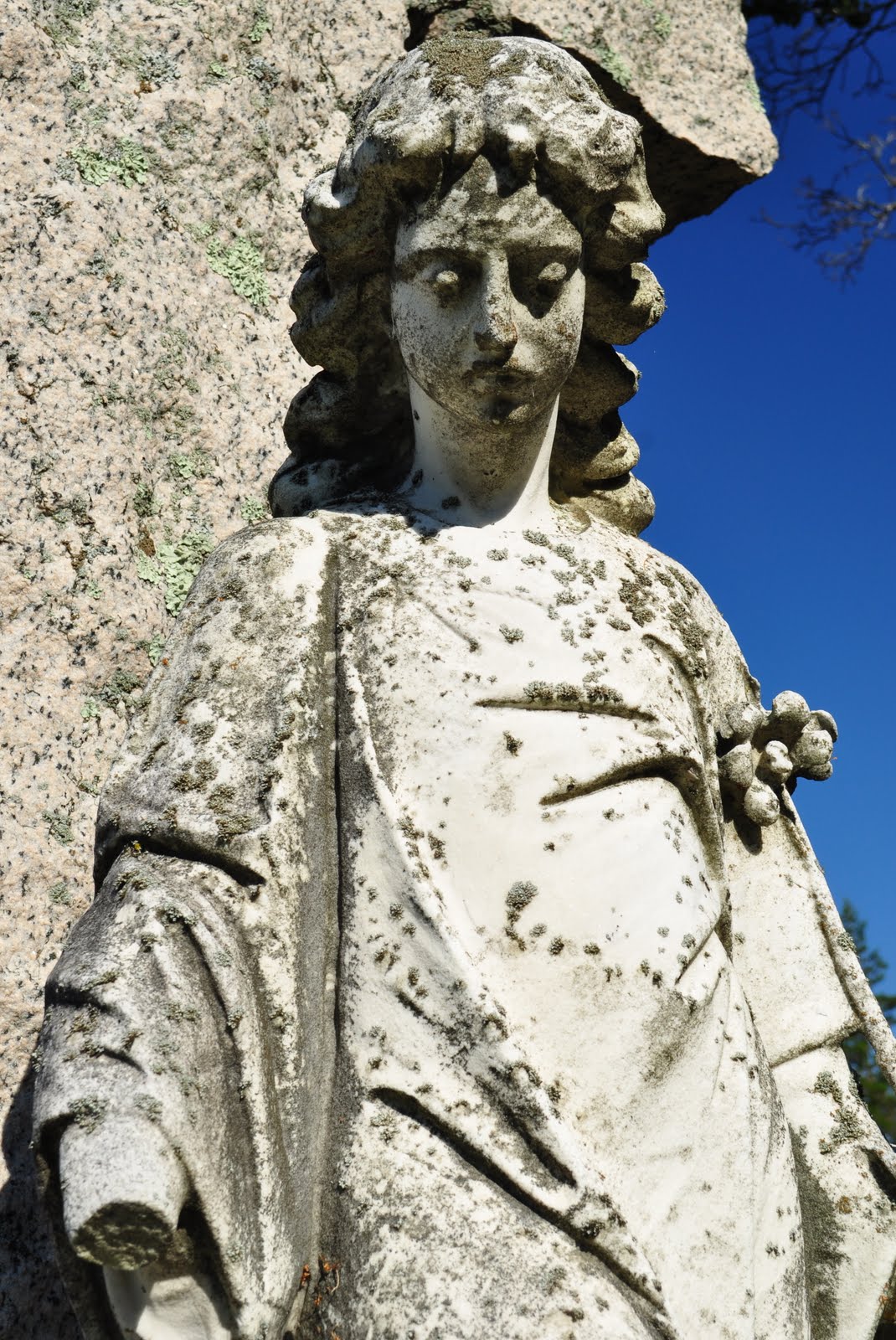
A cemetery is a great place to pick up interesting motifs and symbols. This cemetery is filled with Gaelic motifs. In addition to the Virgin Mary, many gravestone had a Celtic cross, serpentine, shamrock, and that tangled vine like thing (excuse my crude knowledge).

Needless to say, many gravestones are curved Milford Granite. I forgot to mention, the tower is made by Milford Granite blocks, too.

Close up of pink Milford Granite

I found a few pauper graves in the cemetery. I recently learned that many cemeteries in the country have pauper sections. Surrounded by non-pauper Milford granite gravestones, what fate drove them to such a numberless, austere gravestones. There may be no clues to tell their life story from a mere number, but we all have to keep in mind that even they have been labeled as "paupers", each person had a history as important as the rest of us.


After finishing my investigation, I was heading back to my car parked on the edge of the cemetery. The north side of the cemetery was next to a woodland of which ownership was not certain to me. There was newish wires in the woods which seemed to show the boundary between the cemetery and the rest of the forest.

As I walked by the woods, I was wondering who is the owner of that part of property. I was scanning for some nature trails, and suddenly mysterious wooden crosses jumped into my eyes.


The height of the cross was about 3 ft (a meter) high. From a quick observation, there were total 13 crosses on the edge of the cemetery property. (I have to say I don't like the number "13" in this context...) The plot seemed to be cleared recently as I noticed some sawdust on the ground.

As you can see from the pictures above, there were numbered plates on the crosses, indicating there seems to be an effort to distinguish one from another. Are those crosses pauper graves? Or are those recently found burial spots that their existences were somewhat forgotten from us? 

Locate Irish Round Tower @ Google Map

St Mary Milford: http://www.stmarymilford.org/
MACRIS database: http://mhc-macris.net/Details.aspx?MhcId=MIL.802
MACRIS database: http://mhc-macris.net/Details.aspx?MhcId=MIL.900 
 A towering mystery, the Greater Grafton Blog: http://greatergrafton.com/2010/01/06/a-towering-mystery-is-this-an-irish-round-tower/

Monday, August 15, 2011

The Skinny House, Boston


The Skinny House sits on Copp's Hill in North End. The house is across a very old cemetery established in 1659. This skinny structure is said to be built around 1870. It measures 10ft (3m) width, hence the name "skinny", and the narrowest of the interior is mere 6ft (180cm).

A tombstone in Copp's Hill Burying Ground 

Since the house is on the Freedom Trail and in a bustling Little Italy neighborhood, the street is filled with tourists on a summer weekend. But not so many of them seem to notice this quirky house. Is it way too thin to be noticed?

Why is the house so skinny? Good question. Was the land so scarce in this densely populated neighborhood? Maybe.


I learn new words and terms everyday. This house is oddly skinny because it's a "spite house". The spite house is a kind of structure that is built for the purpose of showing your opposition towards surrounding residents and/or certain interest parties.

A land dispute is the common cause of the action, but not limited to. In the case of the Skinny House, the origin is in a mythical level. It could be a dispute between brothers or neighbors; no one knows for sure.

Locate Skinny House @ Google Map 

Here's the interior of the house: http://www.vrbo.com/247506#photos

Monday, August 1, 2011

Dungeon Rock, Lynn


Dungeon Rock is probably one of the most famous New England oddities. Dungeon Rock in Lynn Woods is packed with colorful stories: the legend of pirate's treasure and the quest of a rather obsessive spiritualist family who attempted to find the truth.

Prior to this visit, I and B. visited Lynn Woods for investigating Burrill Stone Tower, a tower built by the WPA in 1936. My companion pleasantly liked the place like I do, so we decided to visit  another curiosity of the woods; the King of (Lynn) Rock.


The legend of Dungeon Rock dates back to 17th century. A pirate ship anchored in Lynn Harbor sometimes around the early to mid 16th century. Their boat sailed up the Saugus River to purchase goods from the Saugus Iron Works. Needless to say, it caught the attention of British Troop, and Captain Harris was eventually caught. However, a crew named Thomas Veal escaped from the capture and was said to hide the treasure in a cave deep in Lynn Woods.

Veal began to settle in the cave. But he suddenly disappeared after the great New England earthquake struck the region in June, 1658. The rumors was that he must have been trapped in the sealed cave alive with the treasure.


In 1852, a spiritualist man named Hiram Marble received the voice of Veal through a medium, giving him a clue of the treasure. He purchased the land around Dungeon Rock, and the family moved into "a two-story wood house located on the flat area just below the cave entrance." (Friends of Lynn Woods) Here we are, his quest for the pirate treasure began. He and his son began digging into the rock.

Lynn seems to possess a mysterious spiritual energy for the Hiram's alike. During the seance sessions carried out at Jesse Hutchinson's stone cottage in Lynn, the spiritualists were sure that they saw angels. These spiritually charged events eventually lead an Universalist minister attempting creating an "Electrical Infant" in 1853, only a year after Hiram set his foot on (or under?) Dungeon Rock. The Reverent believed the abundant nature's energy in Lynn would assist him to advance human life through his creation. (If you want to know more about this bizarre, fascinating story, please refer to my past post: High Rock Tower and Stone Cottage, Lynn.)

Those structures are made by the WPA, not by the Marble's.
Do you know what it is?

Hiram died after 16 years of digging and blowing up the rock. In order to pursue his father's dream, Hiram's son, Edwin kept going for another 12 years until his death in 1880. Did he find the treasure? Unfortunately, no.

Is this Edwin Marble's final resting place?

"At the top of a set of stairs beginning next to the old cellar hole, you will find a large pink piece of rock. This stone marks the grave of Edwin Marble and the end of the quest for treasure." (Friends of Lynn Woods)

This wasn't the first time for me to visit Dungeon Rock, and I had never realized there's a grave right across Dungeon Rock. The realization that Edwin Marble was buried in the spot made me feel uneasy. It's like the feeling when you realize a person has been watching you, peeping at you from a discrete place. He was a spiritualist, so he might have heard our conversation about the "obsessive 19th century family". Ouch!

Don't tell me the red dot in the middle of the photo isn't a speckle of dust!

I'm asking you, B. Who was making an Ouija board joke?


Dungeon Rock is indeed publicly open between 9:00 to 2:30, Tuesday through Saturday (as of Aug. 1, 2011). Don't ask me whether I went...We went there on Sunday; the door was locked! Anyway if I went down and showed you the picture of the cave, that would be a big spoiler for you, right!? Next time, I'll plan to visit during the opening time.

W...P...and what?

A set of inscriptions on the left side wall of the gate caught my attention. For a casual doodling, it looks like too much of a classy job. Who did it? When was it done? And why?

As the digging went on, the Marble's fund went short. In order to fund the project, they opened the dungeon to tourists for 25 cents. It became a 19th century version of an amusement park! Did a bored tourist inscribe his initial while waiting for the tour? Maybe.

Edwin Marble: "I'm watching you!!!!!!!"(Two fingers pointing at me.)

Locate Dungeon Rock @ Google Map

The Friends of Lynn Woods: http://www.flw.org/dungeonrockhistory.htm; http://www.flw.org/landmarks.html#dungeon_rock
The New England Earthquake of 1638: http://www.suite101.com/content/the-new-england-earthquake-of-1638-a127975
Weird Massachusetts by Jeff Belanger
Weird New England by Joseph A. Citro

Sunday, June 26, 2011

Tewksbury State Hospital Cemetery, Tewksbury

Continue from: Stonecroft @ Tewksbury Hospital, Tewksbury


There are two cemeteries for Tewksbury State Hospital. The one I visited is called "the Pines Cemetery". The other is simply called "the Pauper Cemetery". They are located in separate woodlands nearby the hospital. According to the Public Health Museum, approximately 15,000 patients, who had no relatives claimed their bodies, are buried in those no-name cemeteries. Apparently, the records between 1854 and 1894 are missing, but at least the patients deceased between1891 and 1930 are buried in the Pines Cemetery. In the Pauper Cemetery, the burials took place as late as 1960's.

Established in 1892, Tewksbury Hospital was originally called as the Tewksbury Almshouse. Many of them were destitute immigrants notably from Ireland. In addition to the poor, they accepted the "pauper insane", alcoholics, and patients with such contagious disease as TB.

Old Administration Building/ Public Health Museum 

One of the many reasons why I visited the Public Health Museum was to gather information about the cemetery. Usually, consulting a map and some web sites suffice the function. But look at this... 

Google Street View of the Pines Cemetery

No way I'm going to visit the cemetery without the firsthand information, I thought. Helpful guides at the museum provided detailed information about the cemetery, encouraging me to visit there. So I decided to go.


Ok, it doesn't look so intimidating on a hot sunny day. But I didn't bring a bunch of flower...so I went for a rudimentary measure by picking wild flower and put it on a stone hedge. I set my foot onto the pine woods.

There are at least two graves around the snapped tree; click picture to find them

The grave marker in the Pines Cemetery is made of metal and has a cross surrounded by a laurel wreath. Like numerous state hospital cemeteries in Massachusetts, the only information that distinguishes one from another is a number on the center of the cross.

A new guide told me that she was surprised how obscure those markers were when she first visited the cemetery. "If you aren't careful, you'll step on them!" She told me. I was puzzled by her statement because the museum display of the markers were well over 12-inch high.


She was right. Some of the markers were buried deep. 100 years are long time, the forest soil accumulates. The rusty color blended into the surrounding, making it more difficult to spot.


It was the first summer day, hot and humid. Mosquitoes seemed to be waiting for THIS day. I was the prime subject for their feast. I was the walking cocktail platter for them. Why could they sting through my thick, stripy sailor shirt?

Sorry sorry, I forgot a flower bouquet but I searched for an hour...With a rather illogical reasoning for the mosquito siege, I was running through the woods in a nearly panicked state.


Although more sporadic, the markers were located even in the middle of the woods. "How big is the cemetery? Can I go through this?" I began to feel the past and the present were finally connected through the landscape. The sheer number of the anonymous markers spoke about the scale and gravity of the hardship against the destitute.


I finally came to the south side of the cemetery. The grave markers were densely arranged but I somehow felt they were less lonely compared to the sporadically placed markers in the middle of the woods.

One, two, three...Uh-oh

The attack of the mosquitoes became less intense, and I felt more relaxed...But oh boy, I was running on poison ivy.

According to the information in 2004, local volunteers, Eagle Scouts, and Boy Scouts routinely maintain the ground. But it's such a large cemetery; the section the job has done will overgrow again when they finish the last section. Considering from how the grave markers are placed, it is almost impossible to cut the grass with mowing machines. Everything has to be done by hand. Poison Ivy is a big headache among the volunteers.


Fresh paint were on some of the grave markers, suggesting there is a sustained local effort to maintain the ground. But the other location nearby a middle school does not seem to be as maintained as the Pines Cemetery is. Remember, about15,000 people were buried in the two locations. We have a lot of job that has to be done. 


RIP

I thank helpful guilds at the Public Health Museum for providing insightful, valuable information of the hospital, cemetery, and history of public health. I recommend you to visit the museum! Museum URL: http://www.publichealthmuseum.org/

Locate Tewksbury State Hospital Cemetery @ Google Map

http://www.tewksburyhospitalcemetery.ma-vitalrecords.org/recordsindex.html
http://www.tewksburyhospitalcemetery.ma-vitalrecords.org/mota.html
http://www.tewksburyissues.org/phpBB3/viewtopic.php?f=65&t=5797

Saturday, May 14, 2011

Foxborough State Hospital Cemetery II, Foxborough

Continue from Foxborough State Hospital Cemetery

This cemetery was created in 1933 and subsequently expanded that those who remained in the state care even in death would have the dignity of a proper burial. -- Foxborough State Hospital Cemetery
Are we mental patients even in death? Why does the state hide our names? "It has been said that no families have come forward to claim their relatives buried in these cemeteries. WE are their families!" Mark Giles, ex-patient and activist. -- National Empowerment Center


About a month ago, I visited the former Foxborough (or Foxboro) State Hospital and its cemetery. The hospital was established as the Massachusetts Hospital for Dipsomaniacs and Inebriates in 1889. By 1914, the inebriate hospital was transformed to a psychiatric hospital. In 1976, the Foxborough closed its door and was converted to a condo in 2009.


The cemetery was created at the current location during the Great Depression because the state experienced an increase in the number of deceased patients who had nobody to claim their bodies. There are two plots; the one is on Cross Street, the other is "about 125 yards up into the woods". (from Asylum Project) Approximately 1,100 former patients are buried in the plots.


When I visited the cemetery on Cross St, I knew about the existence of the other cemetery. But I wasn't sure about the exact location.

The route to the other plot I introduce today was obscure. There was an unpaved trail between the west side of the Cross St cemetery and a private house that led to the second location. I assume the trail is a public space. Because if not, how do we get there?

Take a right

The cemetery was surrounded by trees but well maintained like the other location. The Foxborough has two sets of number in one gravestone. The one is a patient identification number and the other is the order of burials took place. This location seemed to be older than the Cross St plot since I found a number as old as 4, indicating it was 4th in burials. (I heard you, where's No. 1?)


The ground was covered with a soft carpet of moss, indicating the place is constantly in the shade. A few gravestones were crumbling, making it impossible to read numbers.


"Are we mental patients even in death? Why does the state hide our names?" It is a voice from ex-patient activists while they were investigating state hospital cemeteries in Massachusetts. "The stark anonymity of these markers is disturbing. The state claims that confidentiality regulations do not allow for the release of names of those buried!" (Both from National Empowerment Center)

On the contrary, the state claims that "those who remained in the state care even in death would have the dignity of a proper burial." (From a signboard at the Cross St cemetery, Italicized by S.K.)

The description above was the focus of the past article: what is their definition of "the proper burial with dignity"? My personal observation was that the gravestones with numbers only were far from the burial with dignity; I found it was an impersonal display with no warmth attached, implying the patients were a faceless existence with no identities. The voice of ex-patient activists proves nothing but confirming my thought.


R.I.P.


Locate Foxborough State Cemetery II @ Google Map
Reminder: this location is just behind of a private house. When you visit, please pay respect to the surrounding residents!

Click picture to read

Consumer/ Survivor History Project, National Empowerment Center: http://www.power2u.org/articles/history-project/slides.html
Foxboro State Hospital, Asylum Projects: http://www.asylumprojects.org/index.php?title=Foxboro_State_Hospital