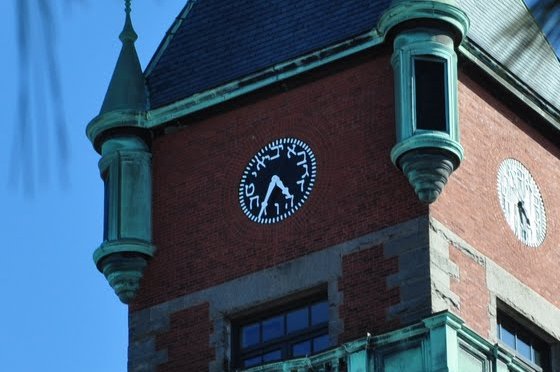
Waltham used to be a watch making town. I knew it used to be a mill town where Francis Cabot Lowell established his first factory in 1814, but I didn't know as "the watch city". Recently, The Backside of America, a blog covers awesome curiosities in New England and beyond, reported about an abandoned watch factory in Waltham (See What a dump). The long deserted small factory nearby a landfill fascinated me. Also it was a rather eye opening experience because Waltham topics in my blog have been about abandoned psychiatric hospitals and its cemetery, not industrial facilities like that. I think now is the time to investigate a different aspect of Waltham.
After shopping a bottle of coconut oil, packet of coriander powder, and bag full of 99¢/ lb plum tomato at a Moody St. Indian grocery, I decided to venture out for the watch city tour. First, I'll show you the Waltham Watch Company.

The precursor of the Waltham Watch Company was founded in 1850 in Roxbury, MA. A new factory in Waltham was built on the Charles River bank in 1854 as the American Watch Company. The gradual additions over next 50 years resulted a huge factory complex with 22 factory units totaling approx. 400,000 square feet. The company's watch became the choice of President Lincoln and various American railway companies.
The Waltham Watch Company went bankrupt in 1949, but the building remained functioning as a multi-use factory and warehouse complex until 2004. Since private developers acquired the complex in 2007, it has been renovated to office space/ apartments, a usual procedure.


I said the factory was on the river bank, but look. It's VERY close to the river! Isn't it little too close to the river? Did the soil erode over the years? What happens if the river floods? Anyway what was the merit of building a factory this close to the river?
Did they use the river for transportation? Well, railroad would be the mode of transportation in the mid 19th century. Anyway, they would have used a canal along the river if there was any around here.
How about using the river current to generate power? The neighboring Lowell's Boston Manufacturing Company mill was also built by the Charles to make use of the river drop for the operation of the power looms. But look, the river current by the watch factory is very placid.
Did they use the river water to cool the metal? Well, it's easy to release the waste to the river as well...I should add I don't know they really did it but quite possibly.


To begin with, why was Waltham chosen by the company? I assume the arrival of the Boston Manufacturing Company in 1814 had established the infrastructure for the mass production of industrial goods. While the Waltham Watch Company is the biggest, there are a handful of other watch companies and watch tool factories in Waltham (the majority of them are converted to other uses like the Waltham Watch Company). As a future reference, a visit to the Charles River Museum of Industry may well answer my question.

Speaking of the museum, there is a little museum open to public. It is located at the main entrance of the converted factory. In addition to displaying the products and tools used, there is a series of description about the company, building, and workers. For example, there was a nursery for the employees' children, and their eyes were frequently examined because a good vision is crucial for the good watchmaker...Today is the day I learned that I would be a crappy watchmaker!


Next, I'm heading to O'Hara Waltham Dial Company, a small watch factory discovered by the Backside Gang.
Thanks for reading, as I always appreciate. Before closing this post, I'd like to ask you a big favor as a Japanese living abroad. Please donate to any charity organizations that you trust for the Japanese earthquake, tsunami and nuclear crisis. I'm from Hiroshima, and the old folks always told us about the severity of the nuclear bomb and its after effect.
Even a small sum helps. No country can handle this crisis without a help from other countries.


Locate Waltham Watch Co. @ Google Map

Click picture to enlarge
The Backside of America: What a dump
MACRIS Database: http://mhc-macris.net/Details.aspx?MhcId=WLT.43
Waltham Watch Factory: http://www.walthamwatchfactory.com/about.html