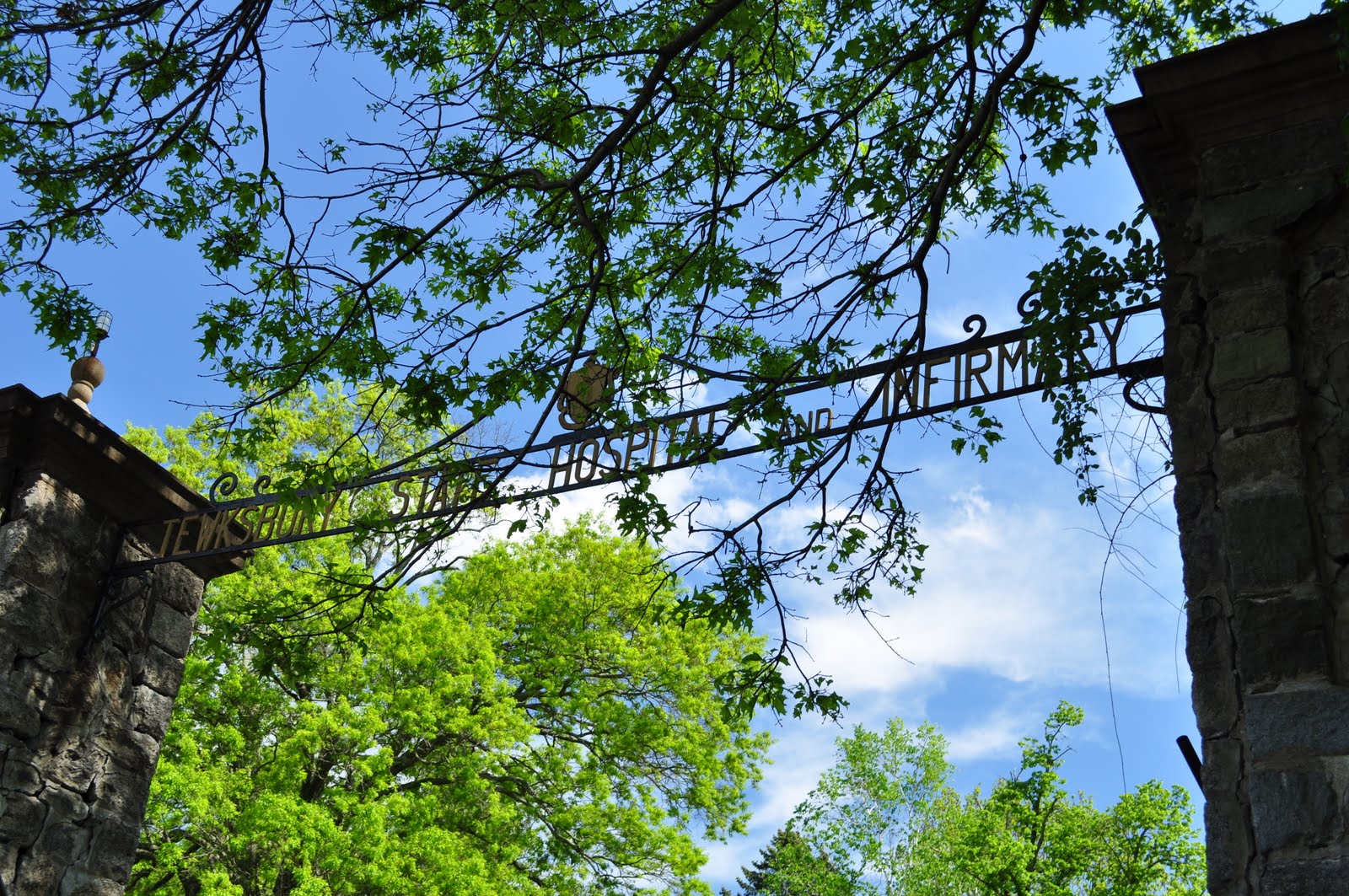
Continue from Tewksbury Hospital, Tewksbury
Conditions at the Tewksbury Almshouse were deplorable. Chronically underfunded, overcrowded and in disrepair, the Almshouse housed an average of 940 men, women and children during the years that Sullivan was there. The mortality rate was very high, and within three months of their arrival, Jimmie Sullivan died. --From Perkins School for the Blind

Stonecroft, Rear
Tewksbury Hospital was established in 1852 as a state-run almshouse. Over the years, the almshouse experienced diversified operation, began accepting "pauper insane" in 1866. Alcoholics were also admitted as a course of expansion. In the early 20th century, more facilities were added to treat patients with TB, small pox and typhoid.

Stonecroft, Front
"It used to be 'the place to die'." The guide at the Public Health Museum said. "It took quite a time to remove the image."
Anne Sullivan's brother Jimmy was one of the numerous sick paupers who were admitted to the Tewksbury just waiting to die. He supposedly died from TB like his mother did. Considering from her background as a nearly blind, destitute Irish immigrant daughter, I'm now very impressed how much Anne achieved in her life. When I was a kid, she's "the teacher of Helen Keller", but now as a grown-up immigrant woman, I cannot help admiring her guts to fight with her tough upbringing.

Bird's eye view of the hospital in 1930's
Looking at a picture drawn in 1930's, the guide kept pointing outlying buildings saying, "this is for TB", "this one is also for TB", "this one, too." He kept going on. The picture was drawn in 1930's. Before the arrival of streptomycin in 1943, good rest, food, and air were the measures against TB.
"This one is for alcoholics."
Finally, something other than TB. Alcoholism was another issue of the time.

From MACRIS database
"We used to admit, what would you say..."
Together with other guide, we began brainstorming for the antiquated term for "traveling homeless who has no intention to work".
"Hobos?"
"Not quite..."
We came up with several words: "vagabonds", "tramps", "vagrants"...anyway, I'll settle as "itinerants".
"They liked Tewksbury over Bridgewater (another state-run almshouse of the time) because they were forced to work there; the rules were very strict at Bridgewater. On the other hand, we didn't force them to work here."
In my mind, the landscape of the interwar London and the US somehow doubled. I guess it's the time to re-read Down and Out in Paris and London.

What is this lodge-like building called "Stonecroft"? After listening to the history of the hospital, I felt this must be related to tuberculosis treatment. I could see this lodge sitting on the hill in Southern Germany or Austria, think about the Sound of Music. All I could imagine from this building was "good air and plenty of sunlight".

TB patients in pre-antibiotic time, from Public Health Museum
However, as the way the facade is clad with dug-up stone suggests, the detail is very vernacular of Massachusetts; I wouldn't be surprised if the WPA built this as a part of job creation projects* during the 30's.
* For the examples of Massachusetts WPA stone-clad structures, please refer to: Slayton Tower, Melrose; Wright's Tower, Medford.

WPA mural at Public Health Museum
Guess what, according to the MACRIS database, Stonecroft was built in 1935, just around the time multiple TB wards dotted the Tewksbury Hospital. There was no mention about the WPA, but I feel the chance is high.

I peeked through a broken window to access the current state of the interior. It seemed to be utilized as a storage space. A cold breeze came through the crack; it was damp and had a smell of dusty mildew. "That's not good for my lung...", I instinctively held my breath.

There is little information available about the original purpose of Sotnecroft. The MACRIS determines this building's significance as "agriculture; Architecture; Health Medicine". Indeed there is an active horse barn just down the hill. The name "croft" also suggest its agricultural nature. My estimation about Stonecroft as the TB ward is quite unlikely; it is more likely one of the farm cottages. But who knows?
I have to remind you that I initially hesitated to post Stonecroft because it sits on a functioning hospital ground. But as an enthusiast of the WPA artifacts, I thought this building is an interesting conglomeration of the history of public work policy, public health, and vernacular architecture; it should attain more positive attention. So, if you know about the history of Stonecroft, I would be delighted to know!

Continue to: Tewksbury State Hospital Cemetery, Tewksbury
Anne Sullivan, Perkins School for the Blind: http://www.perkins.org/vision-loss/helen-keller/sullivan.html
The Public Health Museum, Tewksbury Hospital: http://www.publichealthmuseum.org/index.htm
Tewksbury Mass Historical Properties (PDF): http://www.tewksbury.net/Pages/TewksburyMA_BComm/Historical/list.pdf
Stonecroft, MACRIS database: http://mhc-macris.net/details.aspx?MHCID=TEW.68